Gemini 4 Carbon: The Complete Guide to Google's Most Powerful Model (2026)

Gemini 4 Carbon is Google's strongest model to date, built for hard, long-horizon work: multi-step software engineering, dense research, scientific reasoning, cybersecurity and 3D builds. It became broadly available on November 10, 2026, roughly two weeks after Google first shared it with cybersecurity defenders through the Fairwind Program.
If you build websites, ship software, run research or manage knowledge work, you are probably asking the same practical questions we are: What exactly changed? Is it worth the cost? When should I choose Carbon over Gemini 4 Argon? And how do I get the best results from it?
This guide answers all of that. We read Google's official announcements and documentation, plus independent coverage, and we have kept a clear line between what Google has published and what we recommend based on that information. Where something is a ProCraft opinion rather than a vendor claim, we say so.
Quick navigation
1. What is Gemini 4 Carbon? 2. Release timeline: from Fairwind to general availability 3. Carbon vs Argon: which should you use? 4. Key capabilities 5. Web development and 3D builds 6. Dense research and knowledge work 7. Cybersecurity and the Fairwind Program 8. Scientific and mathematical reasoning 9. Google Antigravity and /swarm 10. How to access Gemini 4 Carbon 11. Pricing and cost control 12. API quickstart and migration notes 13. Safety, security and honesty 14. Best-practice guidelines for prompting Carbon 15. Limitations and things to watch 16. FAQ 17. Final verdict
1. What Is Gemini 4 Carbon?
Gemini 4 Carbon is the top-tier model in Google's Gemini 4 family. Google describes it as its strongest model, with frontier performance in cybersecurity and in long-horizon agentic workflows across complex knowledge work, software engineering and scientific reasoning.
The phrase "long-horizon" is the key to understanding Carbon. Most everyday AI tasks are short: answer a question, rewrite a paragraph, fix a function. Long-horizon tasks are different. They involve many dependent steps, tools, files and decisions, and they can run for a long time. A model that is merely smart can still lose the thread halfway through. Carbon is designed to keep going, explore more thoroughly, and verify its own work as it builds.
Carbon builds on Gemini 4 Argon, which launched about two weeks earlier. According to independent coverage, Carbon is based on Argon and shares its context window, built-in tools and per-token pricing. The main difference is behavioral: Carbon spends more tokens thinking, exploring and running verification loops before it commits to an answer.
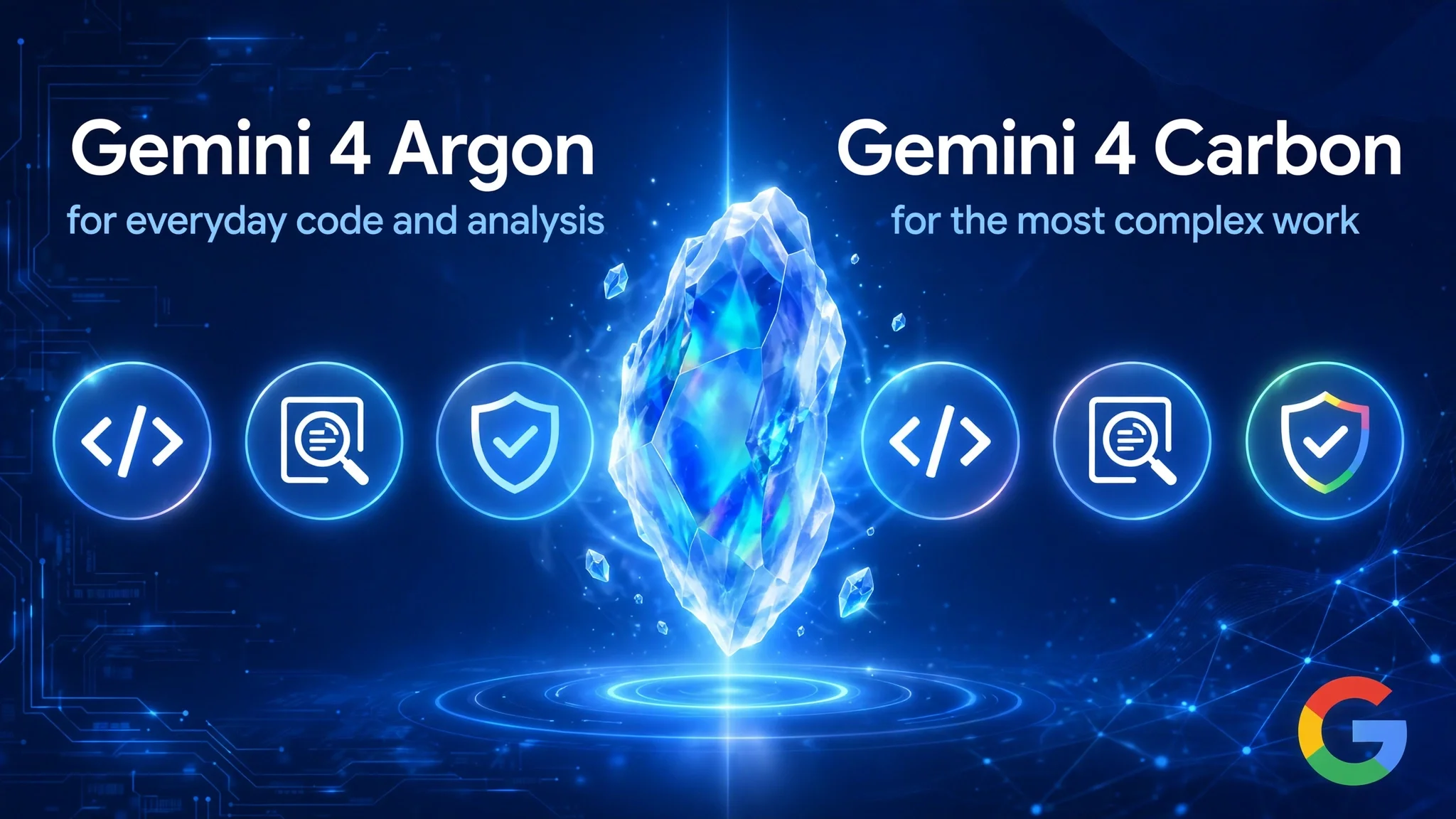
In the Gemini app, the model picker reflects this split. Argon is positioned for "Code & analysis," while Carbon is positioned for "Most complex work."
Key facts at a glance
Key Points
- Model ID:
gemini-4-carbon(andgemini-4-carbon-cyber-permissivefor projects approved through the Fairwind Program) - Context window: about 1 million tokens, as listed in Google's AI Studio model page
- General availability: November 10, 2026
- Introductory price: $2 per million input tokens, $10 per million output tokens (until November 30, 2026)
- Price afterward: $4 per million input tokens, $20 per million output tokens
- Cached input tokens: priced at 95% off the standard input price
- Best for: complex multi-step coding and debugging, architecture, research and discovery, high-precision knowledge work, cybersecurity defense
2. Release Timeline: From Fairwind to General Availability
Understanding the rollout helps explain how Google positions each model and why Carbon arrived the way it did.
Early Sept 2026 — Google launches the Fairwind Program, a limited-access program for cyber defense partners. Sept 30, 2026 — Gemini 4 Argon announced and shared with trusted cyber defenders through Fairwind. Oct 13, 2026 — Argon made generally available via the Gemini API and to Google AI Pro and Ultra subscribers. Oct 28, 2026 — Gemini 4 Carbon announced and shared with cybersecurity defenders through Fairwind. Nov 10, 2026 — Carbon made available to developers, enterprises, scientists and consumers.
The pattern is deliberate. Google releases its most capable models to vetted defenders first, gathers feedback on guardrails, then expands access. The same sequence happened with Argon, and Carbon followed it about two weeks after Argon's public release.
3. Gemini 4 Carbon vs Gemini 4 Argon: Which Should You Use?
This is the question most readers care about, and Google's own guidance is refreshingly clear: Argon remains the ideal choice for the majority of software engineering and knowledge work, while Carbon is built for tasks that test the limits of a model's intelligence.
Both models share the same context window, tools and per-token price. So the real trade-off is not sticker price. It is how many tokens each model spends per task, and how much quality you gain for that extra spend.
Choose Argon when:
Key Points
- You are doing everyday coding, refactoring, code review or documentation
- The task is well-defined and fits in a few steps
- You run high volumes and need predictable cost and latency
- You are building customer-facing features where speed matters
- A strong answer is enough and perfect depth is not required
Choose Carbon when:
Key Points
- A bug spans multiple subsystems and the root cause is unclear
- You are planning a multi-package migration or major architectural redesign
- You need exhaustive research across large sets of dense documents
- The deliverable must follow strict schemas and formatting (spreadsheets, decks, reports) with high precision
- You are doing open-ended scientific or technical exploration
- A wrong answer is expensive, so extended verification is worth paying for
ProCraft recommendation: the hybrid approach
Our practical suggestion is not to pick one model for everything. Use Carbon for the roles that demand the deepest reasoning, such as planning, architecture, coordination and auditing, and use faster models for routine execution. Google describes exactly this pattern in its Antigravity /swarm preview, where Carbon takes the high-level roles while lighter models work in parallel isolated workspaces.
This keeps your quality high where it matters and your costs reasonable everywhere else.
4. Key Capabilities of Gemini 4 Carbon
Google highlights several capability areas. Here is what each means in practice.
Deeper, longer reasoning
Carbon uses more tokens than Argon to explore thoroughly, reason deeply and run extended verification loops. For you, that means better results on difficult problems, but also higher token usage per request. Plan budgets accordingly.
Build-and-verify loops
For web development, Carbon runs build-and-verify loops, recovers from errors, and checks both its code and the rendered UI. That second part matters: the model is not only reading its own source, it is looking at what actually appears on screen and correcting problems.
Exhaustive retrieval and visual understanding
Across legal, finance and enterprise operations, Carbon combines visual understanding, reasoning and thorough retrieval to synthesize grounded insights across large sets of dense documents and data. It is designed to read charts, images, blueprints, schematics and tables natively rather than treating them as afterthoughts.
Strict schema and formatting compliance
Google says Carbon follows strict schemas and formatting to generate polished spreadsheets, presentations and reports. For teams that automate document production, this reliability is often worth more than raw intelligence.
Honesty about missing data
One of the more interesting claims concerns data integrity. Google reports that when data is missing or flawed, Carbon flags it instead of guessing. On a 375-task agentic honesty benchmark, Google says Carbon passed 92% of tasks compared with 70% for Argon. We cover this further in the safety section.
5. Web Development and 3D Builds
Web development is one of Carbon's headline use cases, and it is directly relevant to anyone who builds sites.
What improved
Google reports improved output quality and artifacts in web development, with Carbon rising 89 Elo points to land at number four on WebDev Arena with a score of 1,768. Beyond the leaderboard, Google points to stronger visual design, spatial reasoning and attention to environmental detail, which carry over to 3D game development and creative coding.
Example projects Google showcased
Google demonstrated several builds created with Carbon inside Google Antigravity:
Key Points
- An open-world 3D browser game in which players explore a campus as a pelican riding a bike. Subagents modeled 3D assets in Blender, built the game in Three.js with WebGL shaders, and added procedural sound effects and generated music.
- A redesigned online merchandise store produced in two prompts, with five art direction concepts and newly generated product imagery.
- A cinematic underwater scene built from a video reference, with procedural ruins, volumetric lighting and water simulation modeled in Blender, then converted to Three.js for real-time rendering.
- A playable historical fortepiano reconstructed from CAD drawings and X-ray radiographs, placed in a 3D model of a concert hall with seat-specific acoustics.
- An interactive 3D exhibition of a famous tower's construction, built from historical photos and engineering plates from a single prompt.
- A 906,000-triangle reconstruction of an office built from public planning PDFs across ten overnight loops.
What this means for website builders
For agencies and freelancers like the ProCraft community, the practical takeaways are:
1. Full-stack scaffolding gets faster. A model that builds, runs, looks at the result and fixes errors can take a project much further before a human steps in. 2. Visual polish improves. Better design taste and motion skills reduce the "generic AI template" look. 3. 3D and interactive experiences become feasible for smaller teams. Three.js and WebGL projects that once needed specialists become reachable through guided prompting. 4. You still own quality control. Always test on real devices, check accessibility, and review performance budgets. A model that verifies its own work is not a substitute for your QA process.
6. Dense Research and Knowledge Work
Carbon is also positioned as a research collaborator, not just a coding engine.
Benchmarks Google cites
Google says Carbon ranks first on CursorBench 4.0, Perplexity's WANDR research-agent benchmark, and Zapier's AutomationBench, at more than twice as low a cost per task as the next best external model. Across 200 tasks testing multimodal performance in agentic workflows, Carbon ranks second on the new Multimodal Knowledge Agent benchmark while costing more than six times less per task than the top model, according to Google. A separate report states it ranks first while using three times fewer tokens than the next best model, so treat the exact framing of that benchmark with care and check the original source if you plan to cite it.
On general intelligence, independent testers place Carbon first on the Artificial Analysis Intelligence Index v5 at a score of 59, about nine points above Argon.
Finance and legal
Google reports that in pre-release evaluations Carbon matched the best model tested on a deep financial research agent evaluation, and ranked at the top among 23 frontier model configurations on a general financial intelligence benchmark spanning legal expertise, tool use, coding and perception.
A word of caution on benchmarks
Vendor-reported benchmarks are useful signals, not guarantees. Your workloads, prompts and data are different. Before moving a production workflow, run Carbon against a representative sample of your own tasks and compare quality, latency and total cost against Argon.
7. Cybersecurity and the Fairwind Program
Cybersecurity is where Google leans hardest on Carbon's capabilities, and it explains the staged rollout.
What Carbon can do for defenders
Google says Carbon for cyber delivers its strongest cybersecurity capabilities to date, helping security teams find, exploit (for verification) and patch vulnerabilities. When accessed through the Fairwind Program, Carbon leads on benchmarks for finding flaws (SEC-bench Pro), exploiting them (ExploitGym) and patching them (CWE-bench v1).
Google reports these early results:
Key Points
- In its internal autonomous vulnerability system, Carbon reached 100% recall on scanning and 95% precision on triage, with an over 25% relative improvement in recall over Argon on open source repository testing.
- Google's cloud vulnerability research team used Carbon to prove two bugs in popular open source software were exploitable, helping maintainers reclassify them as critical and patch quickly.
- A cloud security company used Carbon to uncover previously unknown vulnerabilities in two major SaaS providers in under two hours, compressing weeks of research into an afternoon.
Independent coverage adds that Carbon is about twice as likely to generate secure code compared with Argon.
What is the Fairwind Program?
The Fairwind Program is Google DeepMind's limited-access program that gives vetted cyber defenders early access to its most capable cyber models. It launched in early September 2026 for governments, Google Cloud customers and cybersecurity partners, and reportedly had over 650 participating partners at launch. Argon and then Carbon were shared through it first.
For approved projects, there is a dedicated model ID, gemini-4-carbon-cyber-permissive. If your organization works in vulnerability research, incident response or security tooling, you can apply through the program for access on a rolling basis. Standard public Carbon is subject to additional safeguards, which we discuss below.
8. Scientific and Mathematical Reasoning
Google reports strongly improved performance across physics, math and life sciences, including synthesizing experimental data, testing hypotheses and reasoning through multi-step domain problems.
Examples from the announcement
Key Points
- Drug toxicity research: A company working on toxicity prediction reported that Carbon is now its leading model for translational science and found novel toxicity mechanisms it had not previously identified. It is moving production scientific analyses to Carbon and Argon.
- Formal verification: Google researchers built an agentic framework called AlphaProof Code and used Carbon, alongside other models, to help mathematically prove key security properties of the code underlying a widely used encrypted messaging protocol. Carbon generated millions of lines of Lean proof code, and the work took weeks rather than the years such a task historically requires.
- Enzyme assay development: Given only lab notebooks and raw data, Carbon surfaced subtle experimental artifacts, such as incomplete automated mixing, and improved methods for chromatography analysis, tightening the loop between computation and the bench.
- Protein structure prediction: In a multi-agent setup, Carbon discovered remote homologs across enormous sequence archives, increasing the number retrieved by an average of 40 times across seven low-homolog protein families from a blind test set. Google notes broader benchmarking is still underway.
Access for scientists
Google opened applications for 10,000 scientists to receive free access to Argon in Google Antigravity for six months, and says it is expanding access to Carbon for current and future participants. Applications remain open and onboarding is rolling, subject to eligibility, capacity and selection.
9. Google Antigravity and /swarm
Google Antigravity is the agentic development environment where Carbon's long-horizon strengths are most visible. Google is previewing a feature called /swarm that turns a single prompt into a coordinated team of agents you can track in real time.
How the pattern works
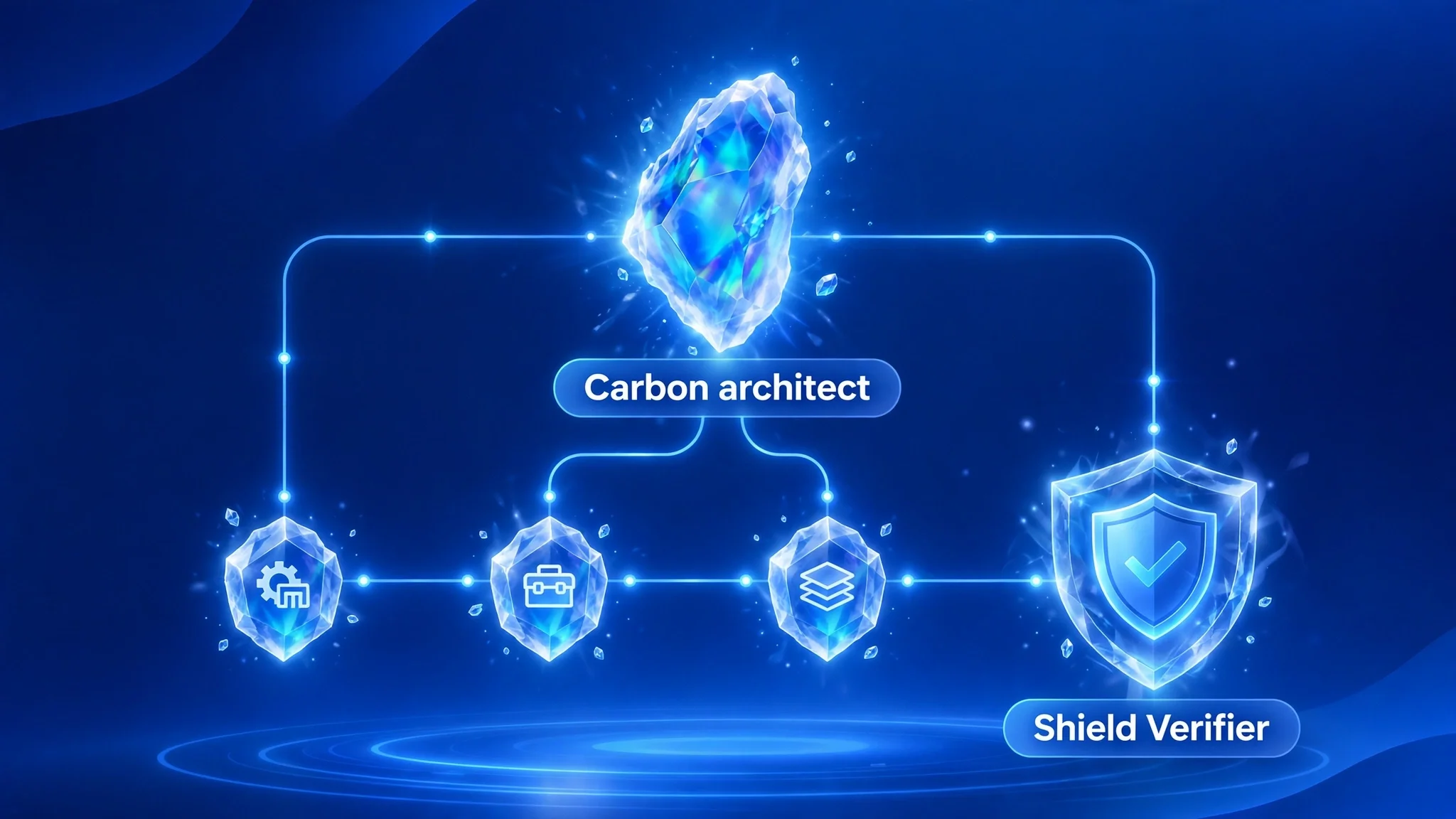
According to Google, developers can assign Carbon to roles that demand the deepest reasoning, such as architectural design, coordination and auditing. They then pair it with faster, lighter models working across parallel isolated workspaces, with adversarial verifiers that test every change.
Think of it as a small engineering team:
Key Points
- Architect and coordinator (Carbon): decomposes the project, sets structure, decides what to build
- Builders (faster models): implement pieces in parallel, in isolated workspaces so they do not collide
- Verifiers: try to break each change before it is accepted
- Auditor (Carbon): reviews the overall result
Google says Carbon performs exceptionally well on engineering tasks that require multi-agent collaboration, such as multi-package migrations, cross-subsystem root-cause investigations and complex architectural redesigns.
Because /swarm is described as a preview, expect behavior and availability to evolve. Check Google's Antigravity documentation for current limits.
10. How to Access Gemini 4 Carbon
Access depends on who you are. Here is Google's own breakdown.
Developers
Key Points
- Gemini API on the paid tier, in Google AI Studio and Android Studio
- Google AI Ultra subscribers can also try it in Google Antigravity and AI Studio
Enterprises
Key Points
- Gemini for business, via the API or the model drop-down
- Google Antigravity and CodeMender
- Google Cloud's agent platform, with a dedicated developer guide
Everyday users
Key Points
- The Gemini app and AI Mode in Search, for Google AI Ultra subscribers
Scientists and researchers
Key Points
- Apply for free access to both Argon and Carbon via Antigravity's highest usage tier for six months
Cybersecurity defenders
Key Points
- Apply to the Fairwind Program for Carbon for cyber on a rolling basis
Note that the Gemini app removed the older 3.1 Pro option with this launch, so Carbon and Argon now sit at the top of the picker.
11. Gemini 4 Carbon Pricing and Cost Control
The numbers
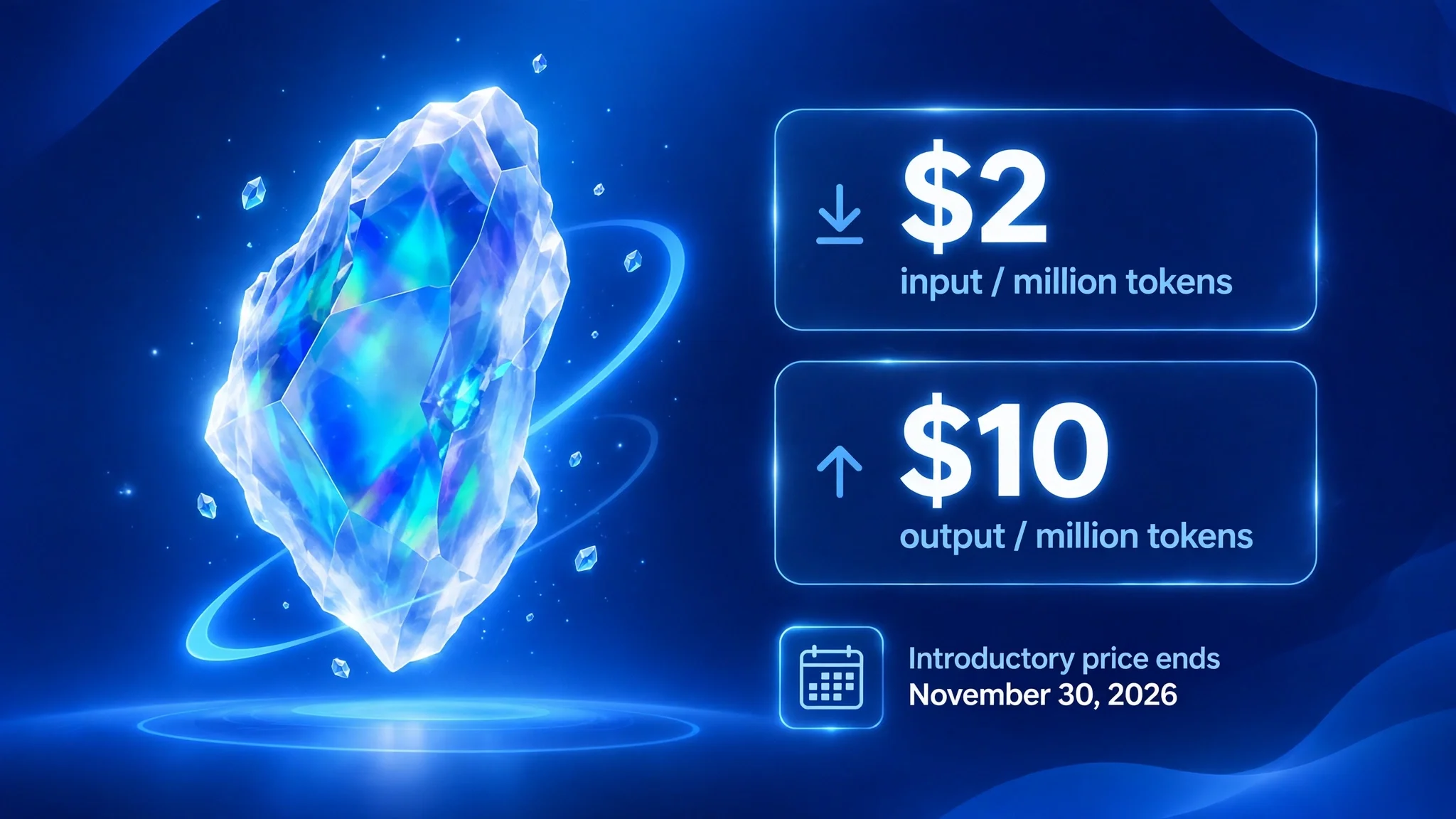
Introductory pricing (through Nov 30, 2026): $2 per million input tokens and $10 per million output tokens. After Nov 30, 2026: $4 per million input tokens and $20 per million output tokens. Cached input: 95% off the input price in both periods.
Carbon launched at the same introductory price as Argon. Because the introductory window ends November 30, the price doubles shortly after this article's publish date. If you are evaluating Carbon, run your benchmarks now at the lower rate, but model your budget at the post-introductory price.
Why a Carbon call can cost more than it looks
Because Carbon spends more thinking tokens per turn, a single request can consume more tokens than the same request to Argon even at the same per-token rate. Output tokens, which include thinking, are the expensive side of the bill. A short visible answer does not mean a short invoice.
ProCraft cost-control checklist
1. Route by difficulty. Send routine tasks to Argon and reserve Carbon for hard ones. 2. Use context caching. With cached input at 95% off, large repeated contexts (codebases, style guides, document sets) become much cheaper. 3. Set budgets and monitor usage. Track token consumption per task type for the first two weeks. 4. Constrain the scope of each request. Clear goals and acceptance criteria reduce wandering exploration. 5. Measure cost per successful outcome, not cost per token. If Carbon solves in one run what Argon needs three attempts for, it may be cheaper overall.
Google also states that Carbon ranks first on several workflow benchmarks at more than twice as low a cost per task as the next best external model. Verify that against your own workloads.
12. API Quickstart and Migration Notes
Google's cloud documentation provides a developer guide for Carbon. Here are the essentials we confirmed.
Model IDs
Key Points
gemini-4-carbonfor standard accessgemini-4-carbon-cyber-permissivefor projects approved through the Fairwind Program
Basic Python call
Using the Google Gen AI SDK, you pass the model ID to a standard content generation call:
Because the model ID is passed with every request, switching between Argon and Carbon is a one-word change. That makes A/B testing simple.
Migrating from Gemini 3.1 Pro
Google's guide includes a side-by-side migration from 3.1 Pro. Two details worth noting:
Key Points
- The model ID changes from the 3.1 Pro preview identifier to
gemini-4-carbon - The
MINIMALthinking level is not supported on Carbon. If your 3.1 Pro code sets a minimal thinking level, remove or change it
SDK versions
Google recommends upgrading to the latest Gen AI SDK. The documentation lists minimum versions for Python, JavaScript/TypeScript, Go and Java for features such as automatic continuation in the Interactions API. Check the current developer guide for the exact version numbers before you deploy, as they change quickly.
Terms to be aware of
Google's documentation notes that Carbon is a Google Frontier Model subject to specific service terms, including abuse monitoring provisions. If you operate in a regulated environment, have your legal and security teams read those terms before production rollout.
13. Safety, Security and Honesty
Stronger capability, especially in cybersecurity, raises the stakes for safeguards. Google says Carbon builds on Argon's multi-layered safety stack, which combines model training, real-time misuse defenses, prompt-injection resilience and chain-of-thought monitoring.
Misuse safeguards (Google-reported figures)
Key Points
- In simulated cyberattack environments, Carbon blocked 99% of attack trajectories from an adaptive red-teaming agent
- The per-attempt breach rate fell to 0.8%, down from 3.1% on Argon
- In a third-party test, automated cyberattack query success dropped to 2.17%, compared with 9.86% on Argon
- An external lab found no new universal jailbreaks across 132 hours and more than 13,000 requests
Honesty and alignment
On Google's 375-task agentic honesty benchmark, Carbon passed 92% of tasks versus 70% for Argon. Google says it declined to fill in missing experimental data 98% of the time and flagged methodological flaws 68% of the time. For research and analytics work, this behavior is valuable: a model that says "this data is missing" is safer than one that invents a plausible number.
Prompt injection
Google reports that Carbon reached a 0% attack success rate on a third-party indirect prompt injection benchmark, which it describes as a first. Google also states plainly that prompt injection robustness remains an area for continued improvement, and that its own red teaming shows room to improve against sophisticated attacks in some distributions.
Our guidance
Treat these as encouraging vendor-reported results, not permission to relax. If you give an agent access to the web, email, files or production systems:
Key Points
- Apply least-privilege permissions
- Keep humans in the loop for irreversible actions
- Log tool calls and review them
- Treat any external content the agent reads as untrusted input
Google has published a full Safety and Security report and a model card for readers who want the primary documentation.
14. Best-Practice Guidelines for Prompting and Using Carbon
The following are ProCraft's practical recommendations, informed by how Google describes Carbon's behavior. They are not official Google instructions.
1. Give it a hard, well-scoped job
Carbon shines when the task is difficult and multi-step. Spending Carbon on trivial requests wastes budget. State the goal, the constraints and what "done" looks like.
2. Define acceptance criteria
Because Carbon runs verification loops, tell it how to verify. Examples: "All unit tests pass," "The page renders without console errors at 375px and 1440px widths," "Every figure in the report must trace to a cited source row."
3. Supply the full context up front
With roughly a million tokens of context, you can include the repository, the style guide, the brief and prior decisions. Pair this with context caching to keep cost down on repeated runs.
4. Specify output schemas and formats
Carbon is reported to follow strict schemas well. Provide the exact column names, slide structure or JSON schema you need.
5. Ask it to flag uncertainty and missing data
Reinforce the behavior Google describes. Instruct: "If any required input is missing or inconsistent, list it and stop rather than assuming."
6. Split planning from execution
For big projects, ask Carbon to produce an architecture and task plan first. Review it, then delegate execution to faster models or to Carbon in stages. This mirrors the /swarm design.
7. Use adversarial review
Have a separate pass, or a separate agent, try to break the result. Google's own multi-agent setups use adversarial verifiers, and the pattern works for human-driven workflows too.
8. Iterate in checkpoints
For long-running tasks, request checkpoints with summaries of what was done, what remains and what assumptions were made. It makes review and recovery easier.
9. Keep a human on the final gate
Especially for security fixes, legal or financial outputs and anything customer-facing. A strong model reduces review effort; it does not eliminate the need for it.
10. Benchmark on your own data
Run the same 20 to 50 representative tasks through Argon and Carbon. Compare quality, retries, time and token cost. Then set your routing rules.
A sample prompt template
15. Limitations and Things to Watch
No model is a magic wand, and honest evaluation includes the downsides.
Key Points
- Higher token consumption. Deeper thinking costs more per task. Budget for it.
- Introductory pricing ends November 30. Costs double afterward, based on Google's published figures.
- Access tiers. Consumer access in the Gemini app is for Google AI Ultra subscribers, and API access is for paying developers and enterprises.
- Preview features may change. /swarm in Antigravity is described as a preview.
- Vendor-reported benchmarks. Many figures come from Google. Independent leaderboards help, but your own tests matter most.
- Not always the right tool. For quick, simple tasks, Argon or a lighter model will usually be faster and cheaper.
- Security remains a shared responsibility. Even with strong safeguards, agent permissions and data handling are your responsibility.
- Moving target. Model names, prices, limits and SDK versions are changing fast. Verify details on Google's official pages before you commit.
16. Frequently Asked Questions
What is Gemini 4 Carbon?
Gemini 4 Carbon is Google's strongest AI model, built for long-horizon, multi-step work in software engineering, knowledge work, scientific reasoning and cybersecurity. It is part of the Gemini 4 family alongside Gemini 4 Argon.
When was Gemini 4 Carbon released?
Google shared Carbon with cybersecurity defenders through the Fairwind Program on October 28, 2026, and made it broadly available to developers, enterprises, scientists and consumers on November 10, 2026.
How much does Gemini 4 Carbon cost?
The introductory price is $2 per million input tokens and $10 per million output tokens through November 30, 2026. After that, $4 per million input and $20 per million output apply. Cached input tokens are 95% cheaper than standard input.
What is the difference between Gemini 4 Carbon and Gemini 4 Argon?
They share the same context window, tools and per-token pricing. Carbon spends more tokens thinking, exploring and verifying, which suits the hardest problems. Google recommends Argon for the majority of coding and knowledge work.
How large is Carbon's context window?
Google's AI Studio listing describes a 1 million token context window.
Who can use Gemini 4 Carbon?
Paying developers and enterprises via the Gemini API and Gemini for business, Google AI Ultra subscribers in the Gemini app, AI Mode in Search and Antigravity, scientists through a free-access program, and cyber defenders through the Fairwind Program.
What is the Fairwind Program?
It is Google DeepMind's limited-access program that gives vetted cybersecurity defenders early access to its most capable cyber models, including Argon and Carbon, often with specialized guardrail configurations.
What is the Carbon model ID?
gemini-4-carbon. Projects approved through Fairwind can use gemini-4-carbon-cyber-permissive.
Is Gemini 4 Carbon good for web development?
Google reports meaningful gains in web development quality, including a rise on WebDev Arena, build-and-verify loops that check both code and the rendered interface, and stronger visual and spatial design for 3D and creative coding projects.
What is /swarm in Google Antigravity?
A previewed feature that turns one prompt into a coordinated team of agents. Carbon can take architect, coordinator and auditor roles while faster models build in parallel and adversarial verifiers test changes.
Is Gemini 4 Carbon safe to use with agents?
Google reports strong results on misuse resistance and prompt injection, and also says robustness against sophisticated injection attacks still needs improvement. Use least-privilege access, logging and human approval for sensitive actions.
Should I switch everything to Carbon?
Probably not. Use Carbon for complex, high-stakes or open-ended work and a faster model for routine tasks. Test on your own workloads to decide.
17. Final Verdict
Gemini 4 Carbon is not a model you need for every request, and Google does not pitch it that way. It is the collaborator you bring in when a project is genuinely hard: many steps, many files, ambiguous root causes, dense source material, or a result that must be right.
For web developers and digital creators, the most exciting part is the combination of build-and-verify loops, stronger visual design and the ability to orchestrate multi-agent builds that reach into 3D and interactive experiences. For researchers and analysts, the focus on honesty about missing data and exhaustive retrieval is just as important as raw intelligence. For security teams, the Fairwind Program offers a controlled path to cyber-specific capabilities.
The practical playbook is simple:
1. Start with Argon for everyday work. 2. Escalate to Carbon for hard, multi-step or high-stakes tasks. 3. Use caching and routing to control cost, especially before the introductory price ends on November 30. 4. Define acceptance criteria and keep humans on the final gate. 5. Benchmark on your own data before changing production workflows.
We will keep this guide updated as Google publishes new documentation, pricing changes and independent evaluations. Bookmark this page and check back.
Explore ProCraft
Key Points
- Browse the free prompt library for copy-ready prompts to use with Carbon, Argon and other models.
- Find tools in the AI directory.
- Try prompts hands-on in the AI prompt studio.
- Learn the basics in our prompt engineering guide.
- Back to ProCraft home.
Sources and further reading
Key Points
- Google: "Gemini 4 Carbon is now available" (Nov 10, 2026) and "Gemini 4 Carbon: our next frontier model" (Google blog)
- Google DeepMind: Fairwind Program page
- Google Cloud: Developer's guide to Gemini 4 Carbon
- Google AI Studio: Gemini 4 Carbon model documentation
- 9to5Google: coverage of the Gemini app rollout (Nov 10, 2026)
- Engadget: coverage of the Carbon announcement
- Real Python: "Gemini 4 Carbon Explained"
- SecurityWeek: coverage of the Argon launch and Fairwind Program
Disclosure: Figures labeled as Google-reported come from Google's announcements and have not been independently verified by ProCraft. Pricing and availability may change; confirm on Google's official pricing page before purchasing.
Explore More Tested Prompts & AI Workflows
Browse 6,800+ copy-ready AI prompts and 5,000+ curated AI tools on ProCraft.