Meta Muse AI Agent: What It Is, How It Works, Pricing, and Is It Safe? (2026 Guide)


For years, AI chatbots have excelled at one specific thing: talking. You ask a question, receive a wall of bulleted text, and then you still have to spend an hour doing the actual work.
Meta Muse changes that paradigm entirely. It is Meta’s personal autonomous AI agent, designed to take an open-ended goal, construct an actionable plan, and execute real-world tasks on your behalf—such as drafting routine emails, booking flights, or comparing e-commerce checkouts—while pausing for your explicit sign-off at consequential moments.
In this definitive 2026 guide, you will learn exactly what Meta Muse is, how its underlying engine functions, what it costs, how its 5-layer security architecture safeguards your privacy, and how to write high-precision instructions for it. We also examine the critical risks and prompt injection concerns you must consider before linking your personal accounts.
What Is Meta Muse?
Meta Muse is a consumer AI agent. That distinction matters:
If you ask a chatbot: “Find me a flight to Dhaka next month,” it produces flight links and leaves the actual scheduling, filtering, and booking up to you.
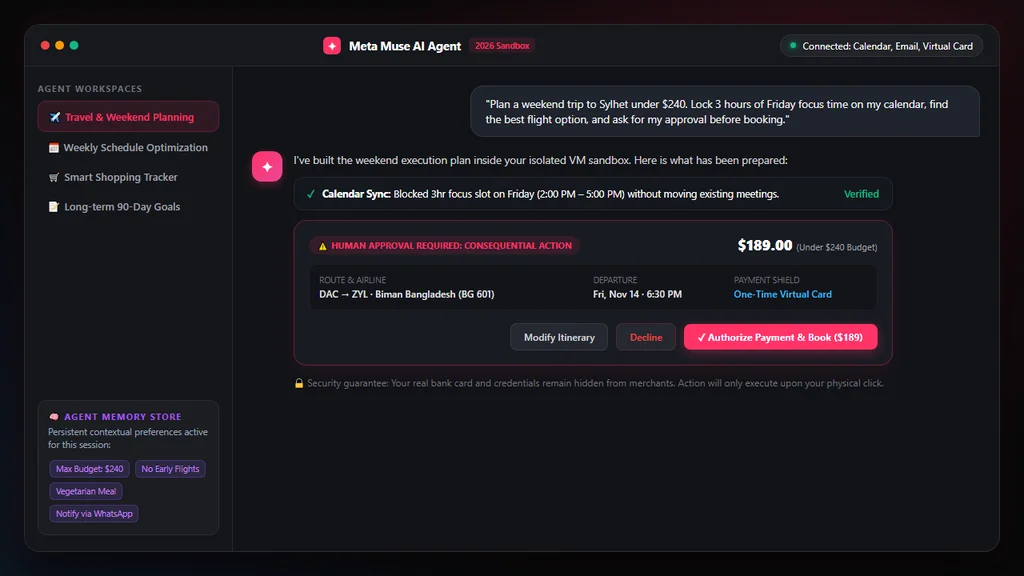
Muse investigates schedule availability, compares routes against your budget, fills out passenger manifests inside a secure sandbox, and displays an approval card for your final click.
Meta positions Muse as a personal assistant for everyday life: managing calendars, coordinating purchases, running errands, and converting long-range ambitions into tangible weekly milestones. Rather than targeting enterprise software engineers exclusively, Meta engineered it for everyday consumers with busy schedules.
Meta Muse vs. Muse Spark vs. Meta AI
Meta’s AI branding can be confusing. Here is the direct breakdown:
| Name | Category | Role & Capabilities |
|---|---|---|
| Meta Muse | Consumer Agent | The standalone personal agent application that carries out actions, plans travel, and manages everyday tasks. |
| Muse Spark | Foundation Model | The underlying AI reasoning model family developed by Meta Superintelligence Labs that powers the agent. |
| Meta AI | General Assistant | The broad conversational assistant integrated across Instagram, WhatsApp, Messenger, and Ray-Ban smart glasses. |
Analogy: Muse Spark is the high-performance engine, and Meta Muse is the finished autonomous vehicle built on top of it.
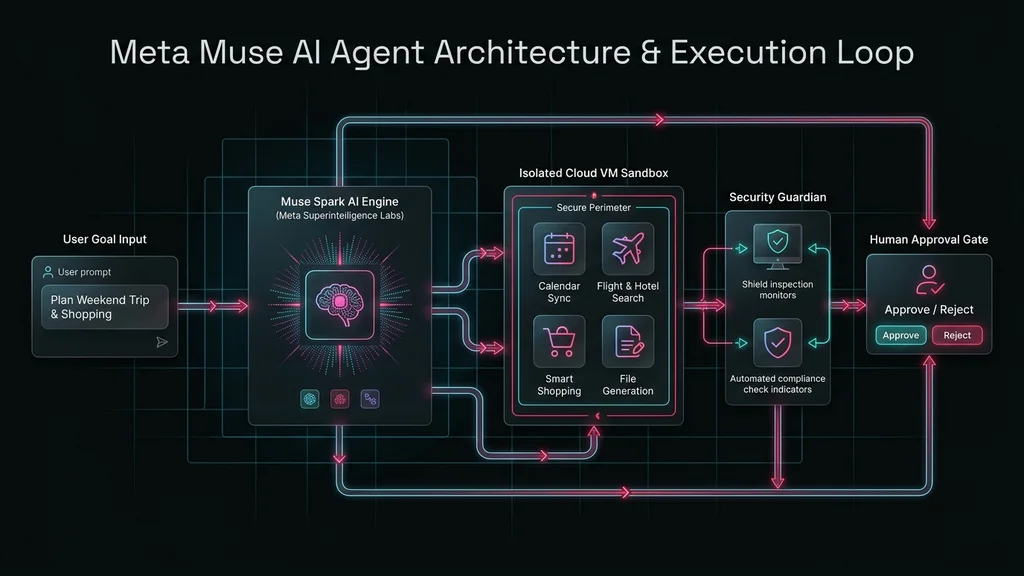
How Meta Muse Works: The 5-Step Loop
Like most state-of-the-art agentic systems, Muse executes tasks through an autonomous feedback loop:
- Goal Definition: You supply an objective (e.g., “Organize a 2-day trip to Sylhet under $240 and block focus hours on Friday.”).
- Plan Formulation: The agent deconstructs the request into chronological milestones and queries relevant data APIs.
- Autonomous Action: Muse executes tool calls inside an isolated sandbox—navigating web pages, querying travel feeds, drafting documents, and staging checkout forms.
- Human Approval Gate: Prior to any irreversible transaction (dispatching an email, placing an order), execution pauses for user review.
- Contextual Memory: Successful outcomes and stated preferences are cached in memory so future requests require zero repetition.
Key Features of Meta Muse
Breaks multi-week projects into bite-sized actionable milestones and checks in on your progress automatically.
Never triggers purchases, financial debits, or external emails without displaying a detailed summary card for your sign-off.
Generates masked single-use payment cards for e-commerce checkouts so merchants never see your actual banking details.
Operate seamlessly across calendar, email, WhatsApp, and social accounts with granular permission toggles.
What Can You Actually Use Meta Muse For?
Here are realistic, high-impact everyday scenarios where Meta Muse saves tangible time:
1. Schedule & Calendar Optimization
Scan the upcoming week, identify fragmented 30-minute intervals, and consolidate them into uninterrupted deep-work focus blocks without rescheduling critical client meetings.
2. Smart Shopping & Price Comparison
Track product price drops across three major retailers, evaluate buyer feedback scores, and prepare a pre-filled checkout cart under your strict spending ceiling.
3. Travel & Flight Planning
Assemble complete multi-day itineraries, compare hotel ratings against personal preferences (e.g. vegetarian breakfast, quiet location), and stage reservations ready for your single-click approval.
Safety and Privacy: How Muse Protects You
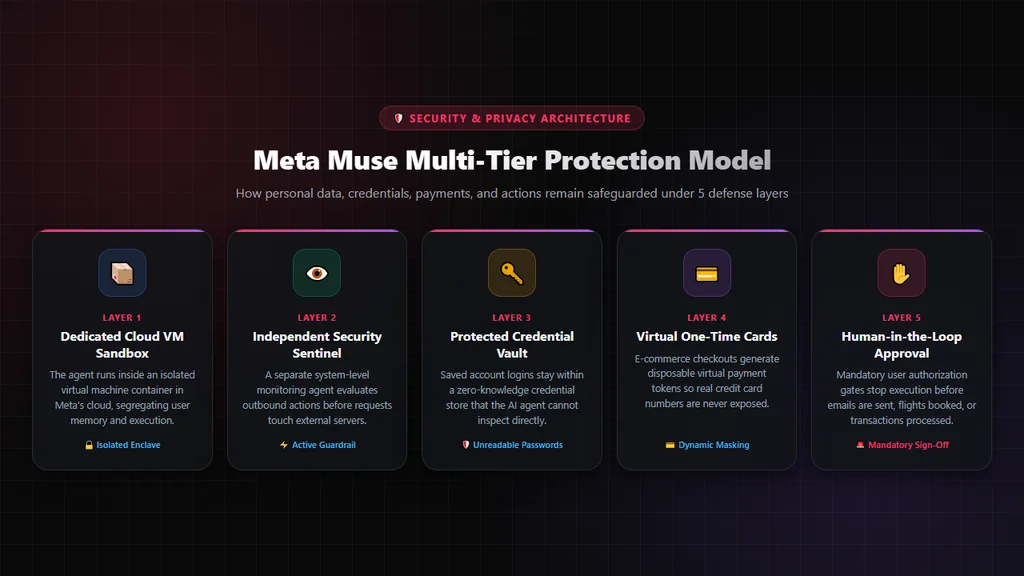
Granting an autonomous AI agent permission to interact with your personal inbox, calendar, and credit card is an enormous leap of trust. Meta engineered a five-tier defense structure to mitigate unauthorized access and prompt injection threats:
What About AI Model Training on Your Private Data?
Under default settings, user prompts and agent interactions may be utilized by Meta to refine upcoming reasoning models. However, users can navigate to Privacy Settings → AI Model Improvement and explicitly opt out. If you do not opt out, Meta asserts that critical personally identifiable identifiers (PII) are scrubbed before dataset ingestion. We strongly recommend opting out if you handle sensitive corporate or personal data.
Meta Muse Pricing & Tiers
Based on official launch coverage, Meta Muse offers a three-tier pricing structure:
Standard rate limits, access to basic scheduling and everyday reminders. Great for casual exploration.
Significantly higher reasoning budgets, faster VM spin-up times, extended memory persistence, and multi-app orchestration.
Dedicated sandbox compute, priority access to cutting-edge Muse Spark checkpoints, and intensive autonomous workflows.
How to Write Better Instructions for Meta Muse
Autonomous agents require far more structural discipline than simple chatbots. The golden formula for commanding personal agents is:
Limitations and Risks to Consider
When an agent inspects external web pages or emails, malicious third parties can embed invisible instructions designed to hijack the agent’s behavior.
If users develop the habit of rubber-stamping approval dialogs without scrutinizing line items, the safety architecture becomes obsolete.
Even advanced models can misread cancellation refund policies or discount voucher terms. Always verify the cart total prior to authorization.
As Muse accumulates months of contextual life preferences, migrating your personal profile to competing agent platforms becomes increasingly friction-heavy.
Checklist Before You Connect Your Accounts
Frequently Asked Questions
When was Meta Muse officially released?
Meta announced the launch of Meta Muse on September 8, 2026, marking its transition into consumer-grade agentic workflows.
Can Meta Muse make purchases without my permission?
No. The agent operates under strict consequential action guardrails. While it can research items, compare prices, and pre-fill checkout forms with one-time virtual cards, completing the final charge requires your physical confirmation.
Is Meta Muse suitable for confidential enterprise work?
Muse is targeted primarily as a personal lifestyle and productivity agent. For corporate compliance, team audit trails, and data isolation, enterprise-focused platforms with formal SOC2/HIPAA guarantees are strongly advised.
Can I interact with Meta Muse through WhatsApp?
Yes. In addition to its dedicated web and desktop applications, Meta has enabled direct conversational task dispatching via WhatsApp integration in supported regions.
The Future Belongs to Agents That Act
Meta Muse represents an unmistakable inflection point in artificial intelligence. Chatbots that merely offer theoretical advice are giving way to autonomous agents that plan, coordinate, and execute real tasks. By understanding how to write bounded instructions and maintaining rigorous supervision at human approval checkpoints, you can harness the power of autonomous AI while safeguarding your personal security.
Build Reliable Prompts for Meta Muse, Claude & Agent Workflows
Ready to build high-performance prompts that never hallucinate or overstep? Explore ProCraft’s AI Prompt Studio and curated Prompt Library. Craft structured instructions, enforce guardrails, and discover battle-tested templates for top AI models.
- Meta Superintelligence Labs: Official Muse Announcement (Sept 2026)
- Meta Help Center: Getting Started with Autonomous Personal Agents
- PBS NewsHour & CNBC: Consumer AI Agent Safety and Privacy Oversight
- Zapier & eesel AI: Technical Architecture and Credential Shield Reviews