7 Secrets to Prompting Claude Fable 5.1 Like a Pro (With Copy-Paste Prompts)
ProCraft Team
•
Nov 08, 2026
7 Secrets of Prompting Claude Fable 5.1 with cute robot working at cybernetic terminal
You have access to one of the most capable Claude models available, and yet your results feel average. The answer is technically correct but twice as long as needed. The code compiles, but it refactored three files you never asked it to touch. The autonomous agent stops halfway through and asks, “Should I continue with step 4?”
That is rarely a model limitation. It is almost always a prompt architecture issue.
Claude Fable 5.1 is engineered for demanding real-world workloads: complex multi-file engineering, high-context research across dense reports, long-horizon tool execution, and nuanced autonomous pipelines. A foundation model this capable rewards prompts that act like a rigorous engineering work order, rather than an ambiguous wish.
This guide delivers seven practical secrets for prompting Claude Fable 5.1 like a senior architect, each accompanied by battle-tested prompt templates. Whether you use Claude via the interactive chat UI or deploy autonomous agents through the Anthropic API, these techniques will instantly elevate your output quality.
Note: Model capabilities, context windows, and API options evolve over time. Always verify current parameter names, extended thinking flags, and context limits in Anthropic’s official documentation. The architectural habits outlined below remain effective across all advanced reasoning models.
Secret 1
Describe the Finished Result, Not Just the Task
Most underperforming prompts describe an activity:
❌ “Look into why my checkout page is slow.”
A high-performance prompt describes an outcome with verification criteria:
✅ “Find why the checkout page loads slowly, fix the most impactful cause, and give me a short report with what you changed and how you confirmed the improvement.”
The first prompt invites a speculative paragraph of theoretical bottlenecks. The second forces an actionable diagnostic, code implementation, and verifiable confirmation.
Bad: “Help me write something about caching.” → Good: “Write a 1,200-word guide for beginners that explains Redis edge caching with copy-paste Docker setup commands.”
Bad: “Fix this authentication error.” → Good: “Fix the failing JWT session refresh bug and confirm the remaining auth test suite runs green.”
Bad: “Review these contracts.” → Good: “Compare these two vendor contracts and generate a Markdown table highlighting every discrepancy in payment schedules, renewal triggers, and liability limits.”
💡 Pro tip: If you catch yourself writing “help me with...” in a prompt, erase it immediately and substitute “deliver...”.
Secret 2
Match the Effort to the Job
Not every task warrants deep, slow, chain-of-thought deliberation. Formatting a JSON schema does not require the same token budget or thinking depth as refactoring a concurrent database locking mechanism or parsing an intricate regulatory filing.
When using Claude Fable 5.1 via the API or clients that support extended thinking or effort dials, treat compute effort as an intentional throttle:
Low Effort
Mechanical Operations
Data reformatting, schema transformations, quick CSS fixes, short lookup queries, and direct translations.
Medium–High Effort
Engineering & Analysis
Feature development, multi-module refactoring, deep research syntheses, API architecture, and test generation.
You can also guide Claude’s internal thinking budget directly inside your prompt instructions:
Effort Allocation Directive
Think deeply about the architectural root cause and concurrency tradeoffs before proposing changes. For mechanical formatting and file renaming, execute directly without extraneous contemplation.
Why this matters: Over-allocating thinking tokens to simple tasks introduces unnecessary latency and billing overhead. Strategic allocation keeps your feedback loop instantaneous.
Secret 3
Draw the Scope Boundary Out Loud
Highly capable frontier models suffer from over-eagerness. When asked to fix a single validation bug, Claude might spontaneously rewrite your state management, rename helper functions, update three dependencies, and format an entire repository.
Always establish strict boundary fences explicitly within a <scope> container:
Strict Scope Boundary Tag
<scope>
Change only what is strictly required to implement the requested behavior.
Do not refactor, rename, optimize, or format unrelated functions or files.
If you identify secondary bugs or code smells, catalog them under a "Follow-up Suggestions" heading rather than modifying them.
</scope>
When patch size and pull request readability matter, specify patch ergonomics:
Minimal Diff Directive
Prefer small, targeted edits over rewriting entire files. Preserve all existing docstrings, comments, and stylistic conventions.
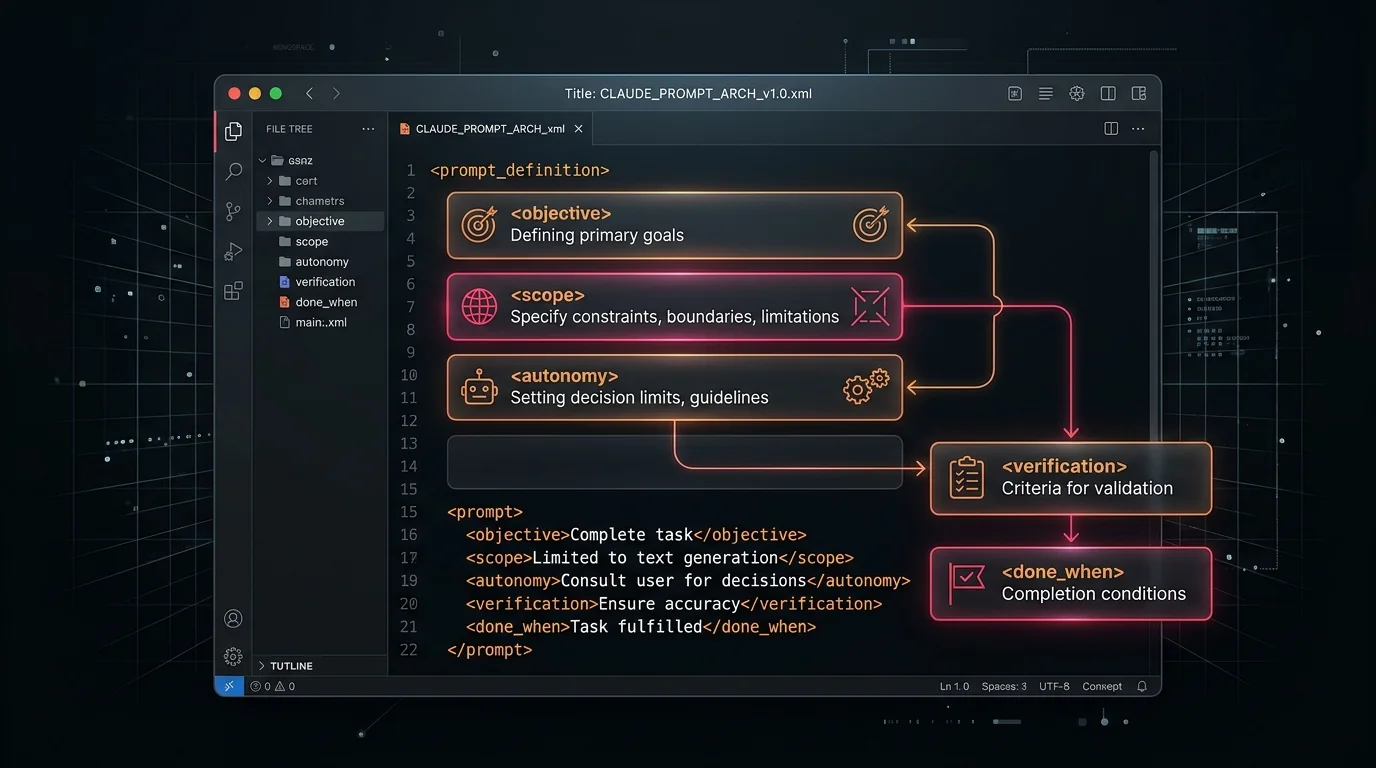
Claude XML Prompt Architecture: Structuring objectives, sources, boundaries, and outputs with clear semantic delimiters.
Secret 4
Decide How Much Freedom Claude Gets
Claude Fable 5.1 excels at multi-turn autonomous execution. However, long-horizon tasks introduce an operational friction point: When should the agent take independent action, and when must it pause for human confirmation?
Without explicit autonomy rules, agents frequently stop midway through a completely benign sequence to ask trivial questions like “I found the file. Would you like me to read it?”
Establish an explicit autonomy framework right inside your initial prompt:
Autonomous Execution & Guardrail Contract
<autonomy>
This initial prompt constitutes complete authorization for all read-only and reversible modifications needed to complete the objective.
Proceed automatically through all in-scope steps without pausing for incremental confirmation.
Pause and request explicit human approval ONLY if:
1. An action is destructive, irreversible, or drops database tables/deletes branches.
2. The core architectural scope or budget constraints would change substantially.
3. Critical required credentials or variables cannot be resolved or inferred safely.
4. Two distinct interpretations would produce mutually incompatible deliverables.
If an individual non-critical sub-task encounters a blocker, isolate it, document the roadblock, and execute all remaining unblocked deliverables first.
</autonomy>
Follow this up with a non-negotiable closure rule:
Do not terminate your turn with a proposed plan for work you can execute right now. Execute that work immediately.
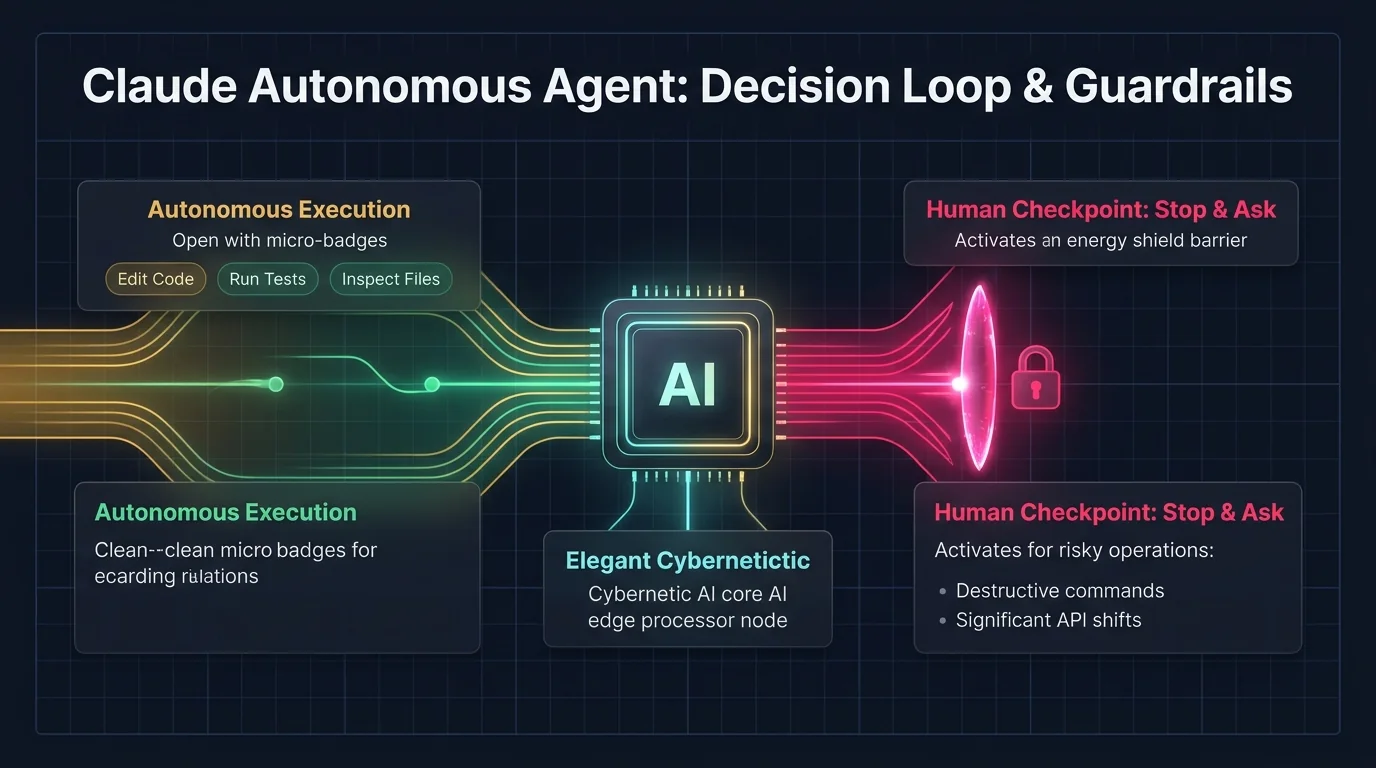
The Autonomous Agent Decision Loop: Clear guardrails separating auto-executed reversible steps from required human checkpoints.
Secret 5
Organize Big Inputs With Clear Structure
When you paste raw terminal output, stack traces, multiple competitor landing pages, or multi-page documentation into a single unstructured text blob, Claude must waste reasoning capacity attempting to parse where one source ends and your instructions begin.
Claude models are specifically fine-tuned to interpret XML semantic delimiters with extraordinary precision:
Multi-Document Analysis Structure
<documents>
<document id="doc_1">
<source>vendor_a_master_services_agreement.pdf</source>
<content>
[Paste Vendor A terms here]
</content>
</document>
<document id="doc_2">
<source>vendor_b_service_order.pdf</source>
<content>
[Paste Vendor B terms here]
</content>
</document>
</documents>
<task>
Compare Vendor A and Vendor B across payment grace periods, SLA downtime credits, and termination liabilities.
</task>
<rules>
- Rely exclusively on evidence provided within the <documents> tag.
- Paraphrase clauses succinctly; only use direct quotes for critical financial metrics.
- If the documents conflict or omit terms, explicitly flag the ambiguity rather than guessing.
</rules>
<output>
1. Markdown Comparison Table
2. Top 3 Legal & Operational Risks for Counsel Review
</output>
Three Golden Rules for Large Contexts:
Place massive source data first: Provide context documents at the top of the prompt and operational instructions at the bottom.
Attribute source IDs: Label inputs (e.g., <file path="src/auth.ts">) so Claude can cite specific line numbers or origin files.
Declare dispute hierarchy: State which source takes precedence when materials disagree (e.g., “In case of discrepancy, current TypeScript signatures supersede README markdown documentation”).
Secret 6
Make Claude Prove It Before It Finishes
Declaring a task “done” is trivial; ensuring it is actually correct requires rigorous validation gates. Never allow an autonomous session to conclude on conversational self-assurance alone.
Enforce a dedicated verification mandate inside your prompts:
Mandatory Pre-Completion Verification Gate
<verification>
Prior to concluding:
1. Run the targeted test suite or linter across modified files.
2. Cross-check every single requirement specified in the <objective> to confirm complete coverage.
3. Perform a git diff self-review to ensure zero extraneous or unintended edits were introduced.
4. Conclude with a dedicated "Verification Report" detailing what was confirmed and what could NOT be verified.
</verification>
For analytical research and strategic briefs, demand cognitive separation:
Require Claude to partition its findings into:
Direct Source Facts: Verifiable facts quoted or cited straight from input materials.
Deductive Inferences: Analytical conclusions drawn from available data.
Recommendations: Actionable next steps based on those inferences.
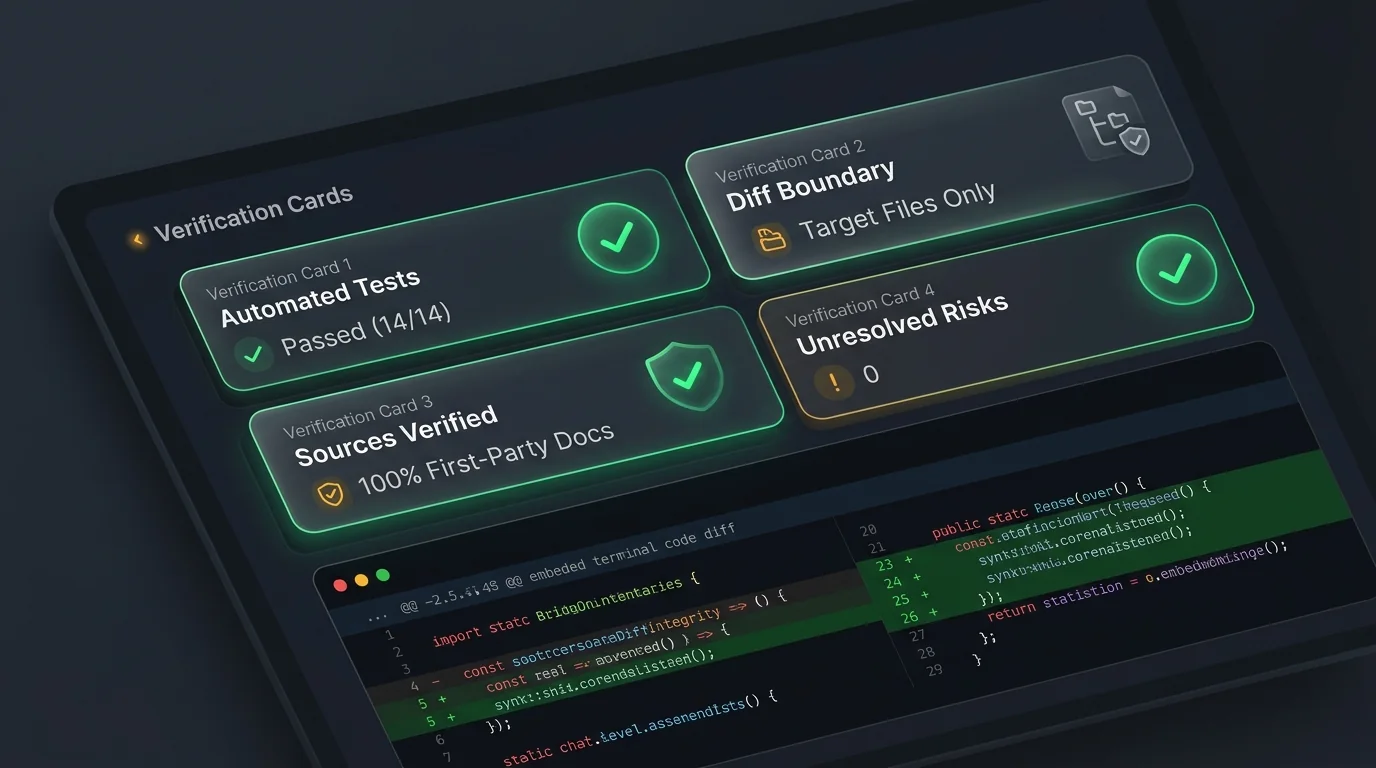
The Claude Task Verification Rubric: Systematic multi-gate verification enforcing syntax checks, unit tests, and scope auditing before delivery.
Secret 7
Shape the Style, and Iterate Like an Engineer
Telling an LLM a long list of negative constraints (“Don’t be verbose, don’t use buzzwords, don’t apologize”) frequently backfires because the model fixates on the negative tokens. Instead, provide positive style parameters.
Direct Style Specification
<style>
Write in direct, high-density technical prose.
Use active voice and short-to-medium sentences.
Use paragraphs for conceptual explanations.
Use headings, tables, and bulleted lists strictly when they enhance scanability.
Omit conversational throat-clearing, introductory pleasantries, and decorative metaphors.
</style>
Treat Prompts Like Code, Not Incantations
Senior prompt engineers treat system prompts exactly like production software. Never overhaul six variables simultaneously when an output falls short. Adopt a disciplined iteration loop:
Step 1
Run
Execute with a baseline test case
Step 2
Inspect
Identify exact point of failure
Step 3
Isolate
Change a single tag or rule
Step 4
Re-test
Compare outputs side-by-side
Step 5
Version
Store winning prompts in a prompt bank
Universal Blueprint
A Reusable Master Prompt Template
Save this master template in your notes or repository. Delete unused blocks for simpler tasks; keep all blocks for complex agentic jobs.
Claude Fable 5.1 Master Production Template
<objective>
[Define the exact finished deliverable, business goal, and what "done" looks like]
</objective>
<context>
[Background architecture, target user persona, tech stack, and environment constraints]
</context>
<sources>
[Authoritative documentation, file paths, API schemas, and conflict resolution rules]
</sources>
<scope>
[Mandatory modifications to implement; explicitly specify what must remain untouched]
</scope>
<autonomy>
[Actions authorized for automatic execution vs. triggers requiring explicit user pause]
</autonomy>
<tools>
[Directives for tool invocation: batch file reads, avoid parameter guessing, verify before reporting success]
</tools>
<verification>
[Concrete tests, build commands, and acceptance criteria required prior to completion]
</verification>
<style>
[Tone, structural density, heading usage, formatting constraints]
</style>
<output>
[Exact schema, sections, tables, or JSON structures required in the final response]
</output>
<done_when>
[Binary condition signaling full task completion]
</done_when>
Field-Tested Templates
5 Ready-to-Use Prompt Examples
1Production Bug Fix with Surgical Scope
Surgical Bug Fix Prompt
<objective>
Fix the session drop issue where authenticated users are logged out immediately after refreshing the dashboard route. Deliver a working code fix and a concise diagnosis.
</objective>
<scope>
Only modify code directly involved in session rehydration inside lib/auth/session.ts and middleware.ts.
Do not refactor neighboring utility functions or re-architect the token store.
Catalog any secondary issues observed under a "Follow-up Suggestions" heading.
</scope>
<verification>
Execute the existing auth integration tests. Verify that page reloads maintain user session persistence and that token expiration still redirects to /login safely.
</verification>
<output>
1. Root cause summary (2-3 sentences)
2. Minimal file diffs
3. Verification results and test output
</output>
2Executive Technical Brief with Evidence Discipline
Executive Technical Research Brief
<objective>
Author an executive evaluation brief assessing vector database options (pgvector vs Pinecone vs Qdrant) for a high-concurrency SaaS product.
</objective>
<sources>
Prioritize 2026 official benchmarks, architectural whitepapers, and documented pricing sheets. Treat community forum posts strictly as subjective sentiment rather than performance data.
</sources>
<rules>
- Verify all current query latencies and hosting costs using search tools.
- Strictly partition the report into:
1. Verifiable Source Metrics
2. Architectural Deductions
3. Strategic Recommendations
</rules>
<output>
- Executive Summary (1 paragraph)
- Structured Matrix (Latency, P99 recall, Cold-start cost, Self-hosting complexity)
- Definitive Recommendation with risk analysis
</output>
3Document Discrepancy & Contract Audit
Document Discrepancy Audit
<task>
Perform a comparative audit between the 2025 and 2026 Master Service Agreements and extract every substantive legal and commercial change.
</task>
<rules>
Rely solely on the provided contract text. Quote short contractual phrases strictly when terminology accuracy is legally material. If any clause appears ambiguous, explicitly highlight it for attorney review.
</rules>
<output>
Markdown comparison table containing:
| Clause Subject | 2025 Language | 2026 Language | Page/Section Reference | Risk Assessment |
Followed by an inventory of critical commercial terms that remained completely unchanged.
</output>
4Educational Content with Voice Control
Educational Engineering Guide
<objective>
Draft a beginner-friendly tutorial explaining Zero-Knowledge Proofs for non-cryptographer software engineers.
</objective>
<style>
Authoritative, lucid, and practical. Demystify mathematical abstractions using intuitive physical metaphors (such as the Ali Baba cave). Short paragraphs, zero academic jargon without an immediate plain-English translation.
</style>
<rules>
Do not hallucinate mathematical formulas. Do not invent benchmark statistics unless citing an established academic paper.
</rules>
<done_when>
A junior frontend engineer could explain the core mechanism of zk-SNARKs to a colleague without feeling confused.
</done_when>
5Autonomous Multi-Step Agent Work Order
Multi-Step Autonomous Maintenance Agent
<objective>
Audit this repository's dependencies, upgrade non-breaking patch and minor versions, resolve deprecation warnings, and verify system integrity.
</objective>
<autonomy>
Automatically apply all non-breaking dependency updates and execute test runs without asking.
Halt and request human confirmation before applying major semver jumps (v2 -> v3) or touching application business logic outside package.json / lockfiles.
</autonomy>
<tools>
Batch file inspections when scanning package configs. Never guess package versions; verify compatibility via registry search tools.
</tools>
<verification>
Run 'npm test' and 'npm run build' following updates. Ensure zero test regressions and zero type errors.
</verification>
<done_when>
All safe dependencies are upgraded, lockfiles cleanly committed in working memory, and a comprehensive audit log is presented.
</done_when>
Quality Assurance
Common Prompting Mistakes to Avoid
Prompting a Topic Instead of a Deliverable
Asking “Tell me about GraphQL subscriptions” generates a textbook summary. Asking “Build a production Redis PubSub WebSocket handler for GraphQL subscriptions” generates working software.
Defaulting to Maximum Effort Unconditionally
Maximized thinking settings for routine transformations inflate latency and cost without yielding perceptible output enhancements.
Omitting Scope Boundaries
Without a strict boundary fence, advanced LLMs spontaneously re-architect peripheral components and disrupt existing git histories.
Skipping the Verification Mandate
Assuming code works because it looks clean guarantees silent runtime bugs. Always compel the model to test and verify its output.
Pre-Flight Routine
The Claude Fable 5.1 Prompting Checklist
Before dispatching your prompt to Claude Fable 5.1, run through this ten-point audit:
Is the concrete deliverable unambiguous and measurable?
Did I provide the exact authoritative sources and context documents?
Did I delineate what to change versus what must remain untouched?
Did I define when the model can act autonomously vs when it must check in?
Are multiple inputs clearly separated using semantic XML tags?
Did I specify the testing command or verification standard?
Did I instruct positive style guidelines (density, tone, structure)?
Did I state the binary condition that signals the task is done?
Is the assigned effort level proportionate to the complexity of the task?
Am I saving this prompt in a dedicated prompt bank for iterative refinement?
Frequently Asked Questions
Frequently Asked Questions
What makes Claude Fable 5.1 unique?
Claude Fable 5.1 is engineered specifically for demanding, high-reasoning workloads including complex multi-file software engineering, rigorous research synthesis, long document comprehension, and autonomous tool workflows.
Are XML tags mandatory when prompting Claude?
No, they are not syntactically required. However, Anthropic’s models are fine-tuned on XML semantics, making tags the most dependable delimiter for separating instructions, contexts, rules, and examples without confusion.
Why does Claude frequently stop and ask if it should continue?
This occurs when prompts lack an explicit autonomy mandate. Claude hesitates to assume permissions for subsequent multi-step actions. Providing an <autonomy> block explicitly authorizing reversible changes eliminates this friction.
How do I prevent Claude from refactoring code I never mentioned?
Enclose your prompt with a strict <scope> directive that instructs the model to modify only what is strictly necessary, maintain existing conventions, and log unrelated code smells under a follow-up section instead of fixing them.
How do I eliminate hallucinated facts in research briefs?
Define authoritative sources explicitly, instruct the model to use search tools for fast-changing data, mandate the cognitive separation of facts from inferences, and instruct it to state when information cannot be verified.
Master the Architecture of Great Prompts
Prompting a model as capable as Claude Fable 5.1 is less about clever phrasing and more about rigorous project management. When you establish explicit deliverables, tune reasoning effort, draw unambiguous boundaries, grant deliberate autonomy, and demand verification, Claude transforms from an unpredictable assistant into your most reliable senior engineer.
ProCraft AI Prompt Workspace
Build, Test, and Refine Claude Prompts with ProCraft Studio
Need production-ready prompts without starting from scratch? Explore ProCraft’s comprehensive AI Prompt Studio and curated Prompt Library. Test variables, structure XML guardrails, and generate optimized prompts tailored for Claude, ChatGPT, Midjourney, and top agentic workflows.